
Private Health Insurance in Australia 2026: Is Extras Cover Actually Worth It?
Private health premiums rose by an average of 4.41% on 1 April 2026, a rise the Minister for Health and Ageing announced back on 17 February. ABC News called it…
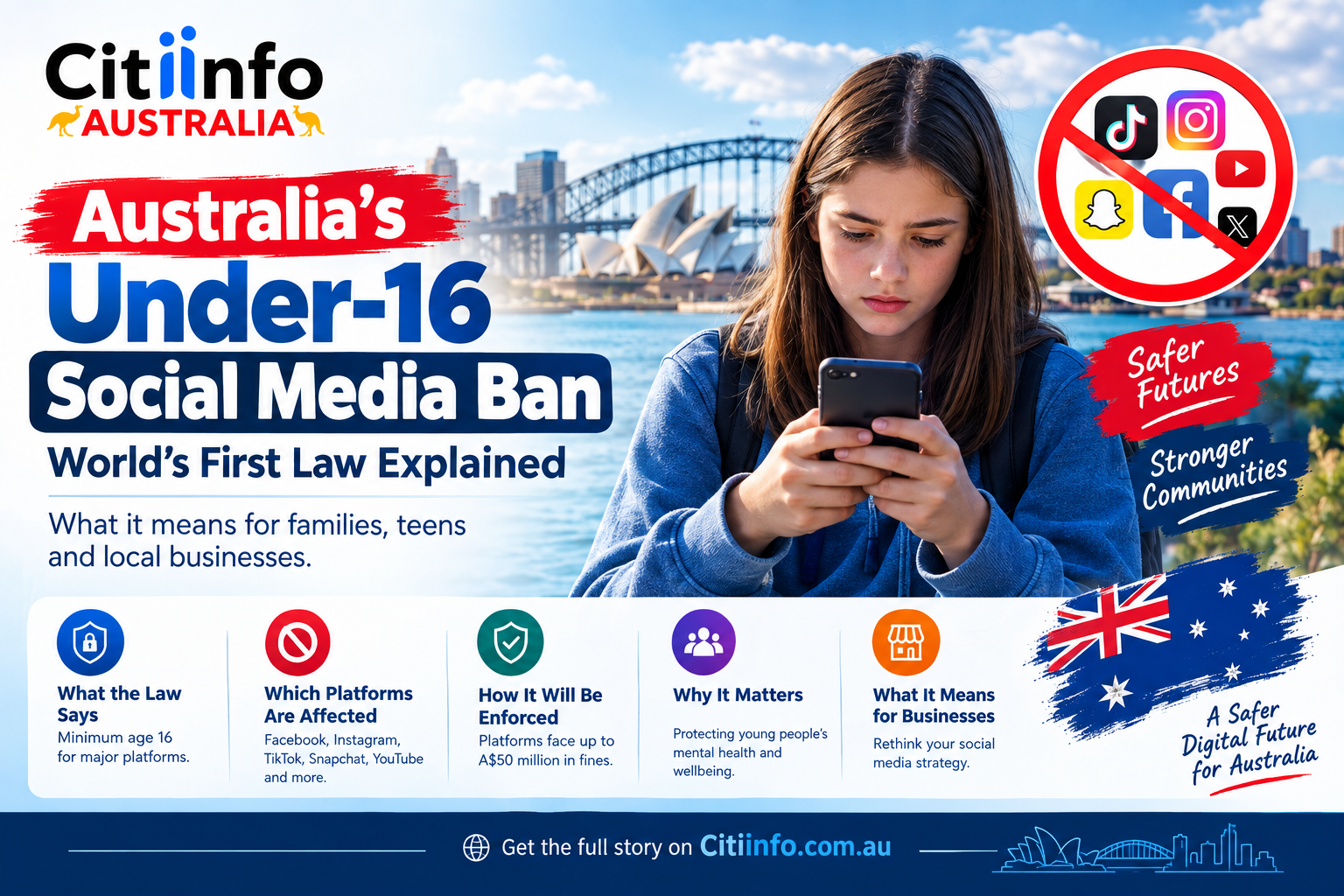
For years, parents, educators and mental-health experts across the country have debated how much screen time is too much for young people. That conversation has now turned into concrete law. Australia's Under-16 Social Media Ban officially came into force in the early hours of a December morning, making the country the first in the world to legally shut major platforms off from anyone under 16. Overnight, roughly a million young Australians found themselves logged out of apps they had used every single day and the rest of the world is watching closely to see what happens next.
This isn't a small policy tweak. It's being described by the country's own leadership as one of the biggest cultural shifts Australia has faced in a generation. So what exactly does the law say, who does it apply to and — just as importantly — what does it mean for everyday Australians and the local businesses that rely on these very platforms to reach customers? Let's break it all down.
Formally known as the Online Safety Amendment (Social Media Minimum Age) Act, the law sets a hard minimum age of 16 for holding an account on major social media platforms. Unlike similar attempts in other countries, this isn't a "please verify your age" pop-up that a curious 13-year-old can click past in five seconds. It places the legal responsibility squarely on the tech companies themselves, requiring them to take genuine, active steps to identify and remove underage users — not on parents, schools, or the children.
The government has been blunt about why it moved so fast on this. Officials point to growing evidence that recommendation algorithms are pushing minors toward content involving bullying, self-harm, sexualised material and graphic violence, often within minutes of opening an app. Rather than trying to regulate the type of content shown, lawmakers decided the simpler and more enforceable fix was to remove underage users from these ecosystems entirely until they turn 16.
The list of banned platforms for under-16s covers most of the household names young people use daily:
TikTok
Snapchat
YouTube
X (formerly Twitter)
Threads
Kick
Twitch
Messaging apps used primarily for one-to-one communication, along with platforms with a clear educational or health-support purpose, generally sit outside the scope of the ban — the focus is squarely on algorithm-driven social feeds rather than every app with a chat function.
This is where the law gets its teeth. Platforms that fail to take "reasonable steps" to block or remove underage accounts face penalties of close to A$50 million per breach — among the largest fines of their kind anywhere in the world. Interestingly, the government also placed limits on how age can be verified: documents like passports or driver's licences cannot be demanded from users as proof of age, a safeguard added specifically to protect the privacy of adult users who don't want to hand over sensitive ID just to keep using an app.
Platforms have been given room to choose their own verification methods, whether that's AI-based age estimation, behavioural signals, or third-party verification tools — as long as the outcome is that underage users are kept off the platform.
Plenty of countries have floated the idea of restricting young people's access to social media, but most have stopped at recommendations, parental-control features, or voluntary industry codes. Australia's approach is different because it carries a legal obligation and a financial penalty attached directly to the platforms, not the families.
The Prime Minister framed the move as reclaiming control from powerful global tech companies, arguing that the wellbeing of an entire generation shouldn't be left to the commercial incentives of platforms designed to maximise time-on-app. The bill moved through parliament quickly, passing the lower house by a wide margin before clearing the Senate, though not without pushback — some critics argued the process was rushed and that vulnerable groups, including LGBTQ+ youth who often use social platforms for community and support, weren't consulted enough before the law was finalised.
The response has been mixed, which is exactly what you'd expect from a change this significant.
Many parents have welcomed the law as a long-overdue circuit-breaker, especially those who've struggled for years to manage screen time battles at home. For them, having the platforms themselves responsible for enforcement — rather than relying on parental controls that tech-savvy kids can often bypass — feels like real support rather than another chore added to their plate.
Teenagers, understandably, have had a more complicated reaction. For many, these platforms aren't just entertainment — they're where friendships are maintained, creative projects are shared and in some cases, where young people found a community they didn't have offline. Losing access overnight has left some feeling cut off from parts of their social world.
Tech companies, for their part, have raised concerns about the practicality of accurate age verification and the speed at which they were required to comply, while some privacy advocates have questioned exactly how platforms will estimate age without collecting more personal data than users are comfortable sharing.
Here's the part that matters most if you run a business, especially one that leans on social platforms for marketing: your audience is shifting and it's shifting now.
If any part of your customer base — or your influencer partnerships, brand ambassadors, or content strategy — has historically skewed toward a younger demographic, this law changes the landscape overnight. A few practical things worth thinking about:
Re-check your audience data. If your Instagram or TikTok followers included a meaningful share of under-16s, expect your reach and engagement numbers on those platforms to shift. It's worth reviewing your analytics in the coming weeks rather than assuming everything stays the same.
Diversify where you're found. Relying on one or two social platforms for visibility has always been risky — regulatory changes like this one are a reminder of why. Being listed on business directories, review platforms, and search-friendly channels gives you visibility that isn't dependent on any single app's rules or user base.
Rethink influencer and youth-targeted campaigns. Brands that market toward teens through creators or youth-focused content will need new strategies, since the platforms carrying that content will legally have fewer teenage eyes on them.
Lean into search and local discovery. As younger audiences potentially spend more time on other apps, search engines and word-of-mouth, businesses that show up clearly in local search results and directories stand to benefit.
This is exactly the kind of moment where having a strong presence beyond social media pays off — and it's a big part of why more Australian businesses are choosing to list themselves on directories like Citiinfo, so they're not putting all their visibility eggs in one (increasingly regulated) basket.
If you want to see how other current events are shaping opportunities for local businesses, it's worth checking out more coverage like this over on the Citiinfo Blog.
Almost certainly, in some form. Several governments, including in Europe and parts of Asia, have already flagged interest in studying Australia's rollout closely before drafting their own versions. Because Australia's law places enforcement responsibility on the platforms with real financial consequences, it's being treated as a genuine test case rather than a symbolic gesture — one that could reshape how the entire world thinks about children and social media over the next few years.
Whatever side of the debate you sit on, there's no denying this is a landmark moment — not just for Australian families, but for the global relationship between governments and Big Tech. For parents, it's a chance to reset habits at home. For teenagers, it's an adjustment many are still processing. And for businesses, it's a timely nudge to make sure your visibility doesn't live and die by algorithms you don't control.
Citiinfo is Australia's growing business directory, built to help local brands get discovered, attract more customers and increase sales online — regardless of what's changing across social media. Whether you're a cafe, tradie, retailer, or service provider, having a strong, searchable listing means customers can always find you, on their terms.
Get listed on Citiinfo today — it's free and takes just a few minutes. Don't let regulatory shifts or algorithm changes decide how visible your business is. Take control of your own discoverability at citiinfo.com.au.
Private health premiums rose by an average of 4.41% on 1 April 2026, a rise the Minister for Health and Ageing announced back on 17 February. ABC News called it…

Tax is one of those things most people only think about when a deadline is close and by then the best opportunities to save have usually passed. The right accou…

In the June quarter of 2026 alone, 111,000 home battery installations were approved under the federal Cheaper Home Batteries Program, adding 3.6 GWh of storage…