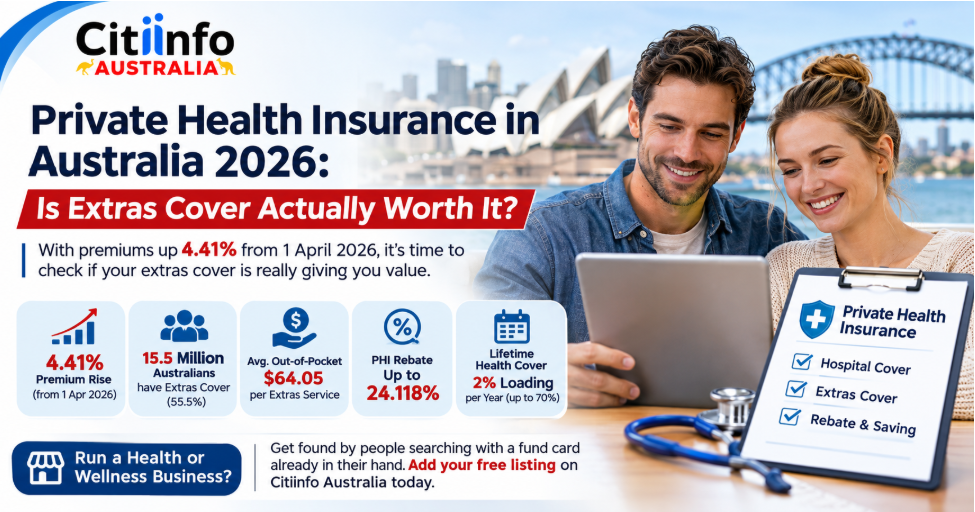
Private health premiums rose by an average of 4.41% on 1 April 2026, a rise the Minister for Health and Ageing announced back on 17 February. ABC News called it the fastest increase in almost a decade. And if you're one of the 15.5 million Australians carrying extras cover, that rise just landed on a product most people have never actually audited.
So let's audit it, using the real numbers and the few rules that actually decide whether your policy is earning its keep.
Run a health or wellness business? Dentists, physios, optometrists and remedial massage therapists get found by people searching with a fund card already in their hand. Add your free listing on CitiInfo Australia, or read how it works first. It's free and takes about ten minutes.
Why this matters in Australia in 2026
Premiums changed by an average of 4.41% from 1 April 2026, announced on 17 February 2026 (Department of Health and Ageing, PHI Circular 11/26).
At 30 June 2026, 15,525,399 people held general treatment (extras) cover, 55.5% of the population. Hospital cover sat lower, at 12,823,752 people or 45.8% (APRA, Quarterly private health insurance membership and benefits summary, June 2026).
Even with cover you still pay. In the June 2026 quarter the average out-of-pocket was $64.05 per extras service, $513.24 per hospital episode and $260.74 per in-hospital medical service where a gap was charged (APRA, June 2026).
Funds paid $1,804.16 million in general treatment benefits in that one quarter, real money going back to members but spread very unevenly between them (APRA, June 2026).
The private health insurance rebate for 2026-27 starts at 24.118% for a single earning $105,000 or less (under 65) and drops to zero above $164,000 (ATO, updated 22 June 2026).
That last point is the one people get wrong most often. The rebate and the Medicare levy surcharge are about hospital cover. Extras does nothing for either.
1. Add up what your extras actually paid you last year
Log in to your fund and pull your claims history for the last 12 months. Not your limits. Your claims.
Say you pay $95 a month for a mid-level extras policy, so $1,140 a year. Across the year you claimed two check-ups and cleans back at $110 each, one pair of glasses at $180, and three physio visits at $45 back. Total benefits: $535. You're $605 down.
That doesn't automatically mean cancel. Maybe you've got two kids heading for orthodontics and you're serving the waiting period deliberately. That's a strategy. But if there's no plan behind the gap, you're paying $605 a year for the feeling of being covered. Run the number before you do anything else.
2. Separate the hospital decision from the extras decision
Hospital cover is the one the tax system cares about. Extras isn't.
For the Medicare levy surcharge, the ATO is specific: an appropriate level of private patient hospital cover means an excess of $750 or less for singles, and $1,500 or less for couples and families. Extras cover, travel insurance and cover from an overseas fund don't count at all.
So if you bought a cheap combined policy mainly to dodge the surcharge, check the hospital excess. If it's $1,000 as a single, you're paying premiums and the surcharge. That's a bad outcome, and more common than you'd think.
3. Understand the rebate tiers before you shop on price
The rebate is a discount the government applies to your premium (or claims back as a tax offset). How much you get depends on your income and your age.
Income (single, 2026–27) | Income (family, 2026–27) | Rebate under 65 | Rebate 65–69 | Rebate 70+ |
$105,000 or less | $210,000 or less | 24.118% | 28.139% | 32.158% |
$105,001 to $123,000 | $210,001 to $246,000 | 16.079% | 20.098% | 24.118% |
$123,001 to $164,000 | $246,001 to $328,000 | 8.038% | 12.058% | 16.079% |
$164,001 or more | $328,001 or more | 0% | 0% | 0% |
Source: ATO, income thresholds and rates for the private health insurance rebate, effective 1 July 2026 to 31 March 2027, page updated 22 June 2026. The family threshold goes up by $1,500 for each Medicare levy surcharge dependent child after the first.
Worked example: you're 42, single, earning $118,000. That's Tier 1, so your rebate is 16.079%. On a policy quoted at $2,400 a year, that's about $386 off. A pay rise past $123,000 drops you to 8.038% and quietly costs you around $193 a year in lost rebate.
4. Don't let Lifetime Health Cover loading push you into the wrong policy
This is the rule funds lean on hardest in their marketing, and it only applies to hospital cover.
If you don't take out hospital cover by the 1 July following your 31st birthday, you pay a 2% loading on top of your premium for every year you're over 30, up to a maximum of 70%. The useful part nobody mentions in the ads: once you've paid the loading for 10 years of continuous cover, it comes off. (ATO, Lifetime Health Cover, updated 5 May 2026.)
So if you're 34 and being told you must buy now or pay forever, that's not accurate. You'd carry an 8% loading, and it would disappear after a decade. Buy hospital cover because you want hospital cover, not because of a countdown clock.
5. Check your annual limits, not the headline list
Extras products aren't standardised the way hospital products are. There's no Gold, Silver, Bronze or Basic here, so two policies that both say "dental, optical, physio" can behave completely differently.
Per-item limits, per-category limits and the combined annual limit are three different things. A policy with a $1,200 "general dental" limit might still cap crowns at $500 each. Percentage back matters as much as the cap: 60% back on a $320 crown is very different from 60% back on the fund's schedule fee. And limits usually reset on 1 January, not on your policy anniversary, so an unused limit in December is money you're about to lose.
6. Watch the preferred provider arrangement
Most funds now have preferred providers where your gap is lower, sometimes zero for a check-up and clean. That's a real saving if there's one near you, and no saving at all if the nearest is 40 minutes away and you end up skipping appointments. Check the list against where you actually live and work before you switch funds for it. Searching local business listings for dentists and allied health in your own suburb tells you quickly whether a fund's network is realistic or just technically true.
7. Price the cash alternative honestly
Here's the inconvenient bit: for a single person with good teeth and no ongoing allied health needs, extras cover often loses. Two check-ups a year paid in cash can come to less than twelve months of premiums, and you keep the freedom to see whoever you want.
Where extras genuinely earn their money is high, predictable, recurring use. Orthodontics. Kids. Glasses every year with a real prescription change. Ongoing physio for a back that isn't getting better. If that's your household, the maths flips the other way and flips hard. The APRA figure above is the giveaway: funds paid out $1.8 billion in extras benefits in a quarter, and the average member still wore $64.05 per service. Extras reduces the bill. It rarely removes it.
8. Switch without resetting your waiting periods
Move to an equivalent level of cover with a new fund and you don't re-serve waiting periods you've already completed. You only serve new ones on benefits you didn't previously hold, or on the part of a higher limit you've upgraded to. Ask your old fund for a clearance certificate and give it to the new one, or the new fund may treat you as starting from scratch.
Premium changes also land on 1 April each year, and your fund has to write to you first. Treat that letter as your annual prompt to redo the audit in section one. Prepaying at the old rate before 1 April is a legitimate saving if your fund allows it, but don't prepay a policy you were about to discover you don't need.
Common mistakes
Buying extras to avoid the Medicare levy surcharge. Extras cover doesn't exempt you. Only hospital cover with an excess of $750 or less (single) or $1,500 or less (couple or family) does.
Judging a policy by its limits. Limits are the ceiling, not the benefit. Percentage back and the fund's schedule fee decide what hits your account.
Forgetting the 1 January reset. Unused limits mostly don't carry over, so booking that second clean in November beats losing the benefit.
Assuming the loading is forever. It comes off after 10 years of continuous cover. Ten years, not life.
Cancelling hospital cover without checking the surcharge. Depending on your income, dropping cover can cost you more in surcharge than the premium you saved. Run both numbers.
Ready to find a provider, or be found?
If you're reviewing your cover, work out who you'd actually see. Browse health and wellness categories on CitiInfo Australia to find dentists, physios, optometrists and podiatrists in your suburb, from Sydney and Melbourne to Brisbane, Perth, Adelaide and Canberra.
If you run one of those practices, a listing is how people find you when they're sitting there with a fund card and a limit to use before 31 December. Add your free listing or get in touch for a hand setting it up.