
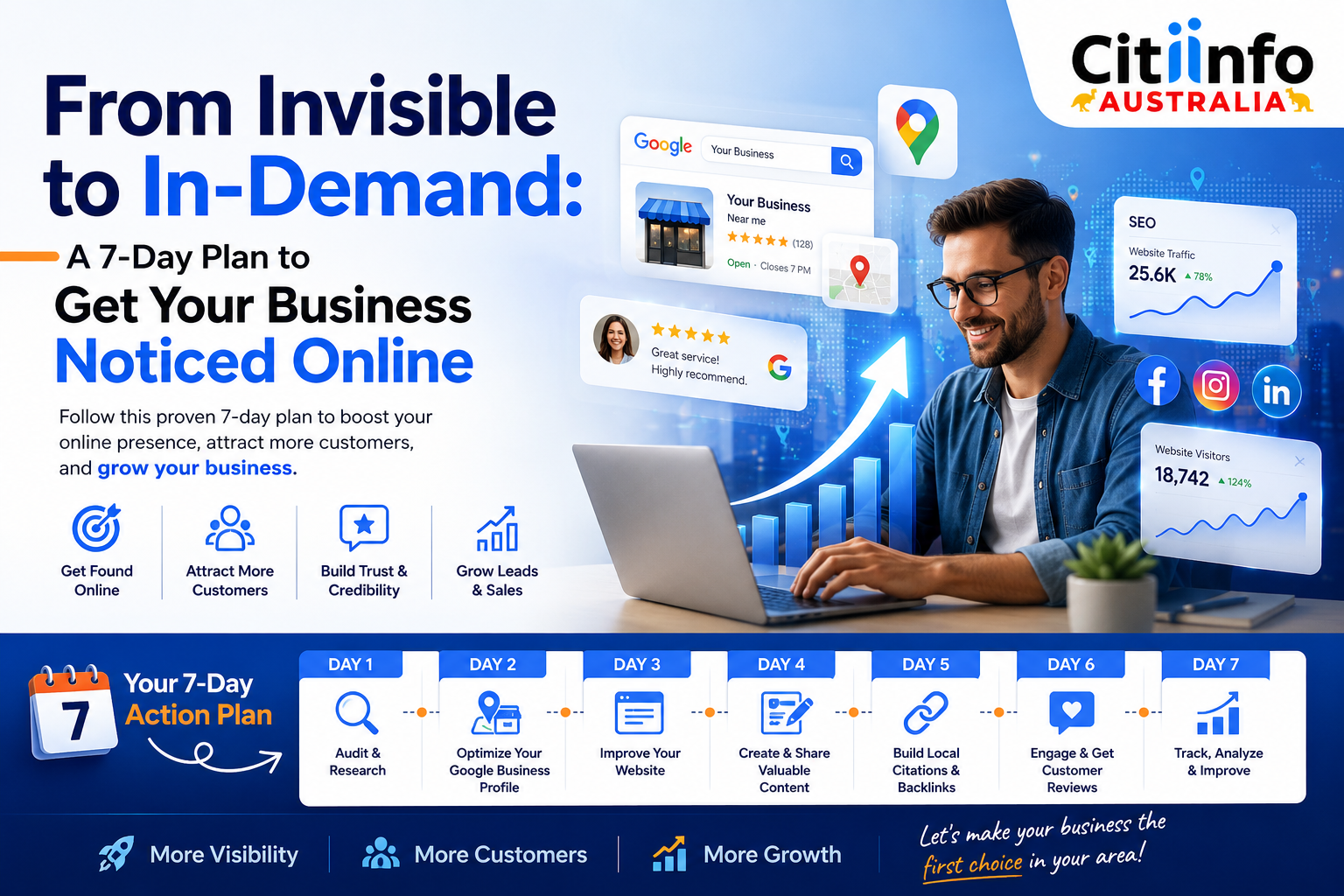
From Invisible to In-Demand: A 7-Day Plan to Get Your Business Noticed Online
If you've ever searched for your own business on Google and felt a little disappointed by what came back — or didn't come back — you're not alone. Thousands of small business owners run great operations that are practically invisible online. The good news is that fixing this doesn't require a big budget or a marketing degree. It requires local SEO for small business, applied consistently, one manageable step at a time.
This guide breaks the process into a 7-day plan. Treat it as your online visibility checklist: each day builds on the last, so that by the end of the week you'll have the foundation of a real small business marketing plan — one designed specifically to get more local customers and get your business noticed online.
Why Local SEO Matters More Than Ever
Most people don't scroll past the first page of search results, and a huge share of local searches — "near me," "open now," "best [service] in [suburb]" — happen on mobile, often followed by a visit or a call within a day. If your business isn't showing up in those moments, a competitor is. Local SEO closes that gap by making sure search engines (and the people using them) can find, trust, and choose you.
Let's get into the plan.
Day 1: Claim and Optimize Your Google Business Profile
Your Google Business Profile is the single highest-leverage asset in local SEO. It's often the first thing a potential customer sees.
Claim or verify your listing if you haven't already.
Fill out every field: category, service area, hours, phone number, and website.
Add high-quality photos of your storefront, team, and work.
Write a clear, keyword-relevant business description without stuffing it full of terms.
A complete, accurate profile signals to Google — and to customers — that your business is active and legitimate.
Day 2: Fix Your NAP Consistency
NAP stands for Name, Address, and Phone number, and consistency here is one of the quieter but more important local SEO for small business ranking factors.
Check that your NAP matches exactly across your website, Google Business Profile, and social media.
Look for old addresses or outdated phone numbers still floating around online.
Standardize formatting (e.g., "St." vs. "Street") so every listing matches.
Search engines cross-reference this information. Inconsistencies create doubt, and doubt hurts rankings.
Day 3: Get Listed in Local and Industry Directories
Online business directories still matter — they're a fast, low-cost way to build legitimacy and earn local backlinks.
Submit your business to reputable directories relevant to your industry and location.
For Australian businesses, a free listing on a directory like is a simple way to appear in local searches, get discovered by category and city, and pick up an additional link back to your website.
Prioritize quality over quantity — a handful of relevant, well-maintained directory listings beats dozens of thin, outdated ones.
Day 4: Optimize Your Website for Local Keywords
Your website should speak the same language your customers are searching in.
Include your city or suburb naturally in page titles, headers, and body copy.
Create or update a dedicated "Service Areas" or location page if you serve multiple areas.
Make sure your site is mobile-friendly and loads quickly — local searchers rarely wait around.
Day 5: Collect and Respond to Reviews
Reviews influence both rankings and buying decisions.
Ask happy customers directly for a review — timing the request right after a positive interaction works best.
Respond to every review, positive or negative, in a professional tone.
Avoid incentivizing reviews in ways that violate platform guidelines; authenticity matters more than volume.
Day 6: Create Locally-Focused Content
Content gives you more ways to show up in search and more reasons for people to trust you.
Write a blog post or page addressing a common local customer question.
Highlight local events, partnerships, or community involvement.
Use location-specific language where it fits naturally, not forced.
Day 7: Build Local Backlinks and Community Ties
Backlinks from other credible local sources tell search engines your business is a genuine part of the community.
Partner with nearby complementary businesses for cross-promotion.
Sponsor or participate in local events, and ask for a mention or link on the event's site.
Reach out to local news sites or blogs for coverage opportunities
Your Online Visibility Checklist, Recapped
Google Business Profile fully completed and verified
NAP consistent across all platforms
Listed in relevant local and industry directories
Website optimized with local keywords
Active review generation and response process
At least one piece of locally-focused content published
At least one local backlink or community partnership in progress
Struggling to get noticed online? A well-planned local SEO strategy helps small businesses build trust, improve their local search rankings and turn nearby searchers into loyal customers. One of the easiest ways to increase your online visibility is by listing your business in a trusted local directory. A quality directory listing can improve your search presence, provide a valuable backlink to your website and help potential customers discover your business when they're actively searching for your products or services. Ready to grow your local presence? Add your free business listing on Citiinfo today and start connecting with local customers who are actively searching for businesses like yours. It's a simple, cost-effective way to improve your visibility and grow your business online.Get Your Business Found by More Local Customers
List Your Business on Citiinfo Today