
Brisbane Open House 2026: 93 Buildings, 16 Private Homes and a Rare Look Inside the City’s Hidden Architecture
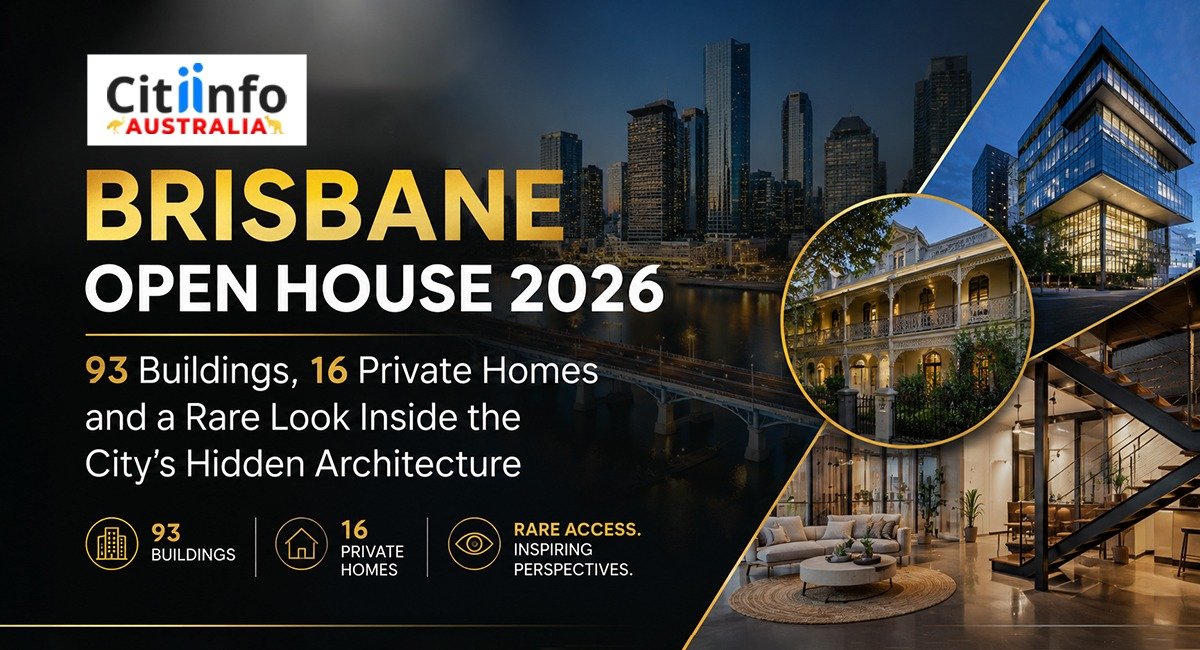
What actually is Brisbane Open House?
Brisbane Open House is part of a broader Open House movement that operates in cities around the world, offering the public free access to buildings — often those that are privately owned, corporately controlled, or otherwise not normally open to visitors — for one weekend a year. The Brisbane edition has grown into one of the city’s most popular cultural events, pairing architecture enthusiasts with everyday residents who are simply curious what’s behind a building facade they’ve always wondered about.
Why do the 16 private homes matter?
Public buildings opening for a weekend is one thing — getting inside a stranger’s home is another entirely. The inclusion of 16 private homes in this year’s program is a significant drawcard because these are typically the hardest access points to secure. Private homeowners have to volunteer their property, coordinate visiting hours, and accept a weekend of foot traffic through their space — something most owners are understandably reluctant to do.
The homes included this year span a range of architectural styles and eras, giving visitors a chance to see how Brisbane’s famous timber Queenslanders have been renovated and extended alongside newer architect-designed builds that reflect the city’s more contemporary design trends. For anyone renovating, building, or simply interested in how other Brisbane homeowners have solved problems like flood resilience, cross-ventilation, and indoor-outdoor living, these homes offer real, walk-through case studies you can’t get from a magazine spread.
What else is on the program?
Beyond the private homes, the 93-building program spans commercial towers, civic buildings, heritage-listed sites, and community spaces across greater Brisbane. Visitors have historically been able to explore everything from council chambers and university buildings to churches, theatres, and industrial heritage sites that rarely allow public access outside of this event. Guided tours, talks with architects or building custodians, and self-guided exploration are typically offered depending on the venue.
How does the event usually work on the day?
Brisbane Open House runs as a self-directed weekend experience rather than a single ticketed event. Most participating buildings are free to enter across the Saturday and Sunday, though some — particularly the private homes and highly sought-after venues — require registration in advance due to limited visitor capacity per hour. Popular sites can draw queues, so building a rough itinerary ahead of time makes a real difference to how much of the program you can actually see across the two days.
How has the event grown over the years?
Brisbane Open House has expanded steadily since its early editions, both in the number of participating buildings and in the diversity of what’s on offer. Earlier years leaned more heavily on civic and commercial buildings simply because those are easier to secure — building managers and councils are generally more willing to open doors than individual homeowners. The growth to 16 private homes this year reflects years of relationship-building by organisers with the local architecture and design community, who often act as intermediaries encouraging clients and colleagues to volunteer their properties once they see how well previous years have been received. That steady growth in private home participation is often cited by organisers as the clearest measure of how embedded the event has become in Brisbane’s design and architecture scene.
What role does the event play in Brisbane’s broader design community?
Beyond the public-facing weekend, Brisbane Open House has become something of an informal showcase for the city’s architecture and design industry. Architects and building custodians volunteering their time to guide tours use the weekend as a chance to discuss design decisions directly with the public, students and prospective clients — a rare direct line between practitioners and the community they design for. For a city whose architectural identity has often been defined by the traditional Queenslander, the event has also become a platform for showing how that heritage is being reinterpreted in contemporary builds, giving visitors a tangible sense of how Brisbane’s housing stock is evolving.
What should you do to plan your weekend?
A few practical tips for getting the most out of the 18–19 July weekend:
Check the official Brisbane Open House program in the days before the event, as building lists, time slots and any registration requirements are typically confirmed closer to the date.
Prioritise the private homes and heritage buildings first — these are the hardest to access outside the event and tend to fill their visitor slots earliest.
Group nearby buildings into a walking loop rather than criss-crossing the city, since many participating sites cluster in the CBD, New Farm, West End and inner northern suburbs.
Bring comfortable shoes and expect stairs — many heritage buildings and multi-storey homes don’t have lift access for the public tour.
If you’re an architecture student or renovator, bring a notebook — building custodians and architects on site are often happy to talk through specific design decisions if you ask.
The bigger picture
Events like Brisbane Open House do more than satisfy curiosity — they quietly build a shared sense of ownership over a city’s architecture and history. When 16 private homeowners agree to open their front doors to strangers for a weekend, and dozens of building managers coordinate volunteer guides and extended access, it reflects a genuine civic appetite to demystify the spaces that make up Brisbane’s skyline and streetscape.
With winter school holidays only just wrapping up and Brisbane’s calendar filling out through the back half of July, Open House weekend is shaping up as one of the city’s stan